Thursday, March 24, 2022

He Tāua, He Tāua

Create a DLO that helps students learn the actions of the haka He Tauā, He Tauā. These resources will be used to help the junior classes learn the haka. 

Boys create a DLO of the boys actions.

Girls create a DLO of the girls actions.


Panmure Bridge School Haka.


K:  He tauā, he tauā!

K:  A war party, a war party!


R:  I ahaha!

  Yes indeed!

He tauā matatini, he tauā mata-kahi-kātoa

A war party of many faces, a war party who carry tools

  E kari nei i te māra tapu o te mātauranga

      to dig in the sacred garden of knowledge 


K:  Ko wai rā, ko wai rā?

       Who are we, who are we?


Ko te pou ki mua ko Te Hoe o Tainui.

The foremost pillar is Te Hoe o Tainui

Ko te pou ki waho ko Waiheke

The outer pillar is Waiheke

Ko te pou ki uta ko Mokoia e!

The inner pillar is Mokoia


Ko te pou ki uta ko Mokoia e!

      The pillar of the descendants is….


Koia Pāoa! koia Pāoa!

      It is Pāoa! It is Pāoa!

      ko te parekura!

      From calamity and destruction

      ko te hupane….hupane, kaupane whiti te rā!

      We have risen again!

      Hī!!


Wednesday, March 23, 2022

Tāwhirimātea LS2 Work

Our students in LS2 have been learning about Tāwhirimātea and the myth and legend surrounding the separation of his family. 

Monday, March 21, 2022

Tāwhirimātea – god of the weather

Tāwhirimātea


 Watch the video above and complete the following tasks.

1) Find and write down the sentence in English that that uses the words ki runga, ki raro. For an extra challenge try and write the sentence down in Māori by listening to the words.

2) What does Ngā mata o te ariki, o te Ariki mean in English?

3) Write a story explaining what the video was about. Consider the following questions.

  • Who is the story about?
  • What was the main character angry about?
  • How do we know the main character is angry?
  • What did the other gods want to do about Ranginui and Papatūānuku?
  • What does the main character have to do with the story of Matariki?
4) Attempt drawing Tāwhirimātea, whether its a physical picture of him or a representation of what he is. E.g. the different elements of weather. What it looks like when Tāwhirimātea is upset/angry. 

Whānau - Jr School

 Vocabulary 

Whānau - Family

Māmā - Mum


Pāpā - Dad


Koro - Grandfather


Kuia - Grandmother


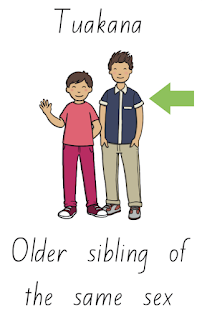
Tuakana - older sibling of the same gender


Teina or Tena  (both are correct spelling) - younger sibling of the same gender


Tuahine - sister of a boy


Tungāne - brother of a girl


Activity

Create a family portrait using traditional Māori koru's. 

Step 1) Practice your koru's on a whiteboard or scrap paper. 

Step 2) Draw and colour a koru to represent each family member.

Step 3) Glue them to a piece of black paper.

Step 4) Label your family members using the terminology above. 


Sunday, February 27, 2022

How Aotearoa came to be


Aotearoa

Watch the video below that tells the story of how Maūi fished up the North Island and how his voyage to visit his mother Papatūānuku resulted in the creation of the South Island. 


Year 7 & 8 Task

Digitally design the North & South Island based on how the Myth and Legend depicts them to look. Consider how your digital art helps to tell the story of Maui and how New Zealand came to be. 


Year 4, 5 & 6 Task

Students are to create a comic book that retells the story of the Myth and Legend. 


Junior School

Watch the video above, discuss the story. Students can draw a picture about the story and write a sentence about what they learnt. For new entrance students, teacher can dictate their sentence. 

Extra activity - there is a colouring in picture of Māui for students to colour in.


Monday, February 14, 2022

Te Ika a Māui (Juniors/Middle)

Read the story Te Ika a Māui or watch the video below. Talk about the story so students have a good understanding of the Māori myth and legend. Who are the main characters? What happens in the story?


 Māori Version

English Version

Below is a picture of a waka known as the South Island and an ika (fish) known as the North Island. Get students to draw their own fish and their own waka to symbolise the North and South Island. Label their pictures using the vocabulary below.

Vocabulary


Tail - hiku  (he-coo)
Head - Upoko
Fish - ika (ee-car)
Ocean - moana (more-un-ah)
Wing - parirau (puddy-rau)
Stomach - puku (pook-ew)
Water - wai (why)
North Island - Te Ika a Māui 
South Island - Te Waka o Aoraki 


Juniors school: Juniors can colour in the attached picture. Students can draw a picture of an ika on Maui's hook. Link to picture

Extra Challenge: For an extra challenge get students to label their picture in full sentences. E.g. Te upoko o te ika (the head of the fish), te hiku o te ika (the tail of the fish).

Mihi

 Mihi is a traditional Māori greeting. They are used as formal welcome speeches, expression of thanks or just to identify who you are and where you have come from. Your mihi can be long or short. 

The hardest part about your mihi is standing up and saying it with confidence and saying it with confidence is so important. Your mihi is all about you and your family so speak of yourself and your family with pride and confidence.This comes with lots of practice saying it. Say it in the mirror every morning, say it in the shower, say it to your friends.  

Watch the video and read the examples below for extra help.