Showing posts with label PBSTeReoMaori. Show all posts

Sunday, May 15, 2022

Powhiri


Seniors: Create an informational poster or DLO answering the following questions.
Juniors: Watch the video and talk about what a powhiri is. Get students to draw a picture (on their iPads or on paper) and write a sentence about one thing they learnt. 
  1. What is a wero?
  2. What is a karanga?
  3. Who does the karanga?
  4. Who are the manuhiri?
  5. What does whaikorero mean?
  6. What does koha mean?
  7. What does a hongi represent?
  8. During a powhiri, women walk on first. What is the reason for this?
  9.  What marks the end of the powhiri?
  10. Is there anything else you learnt/ know about a powhiri?

Wednesday, April 6, 2022

Juniors - Fortune Tellers

Watch the video below on how to make a fortune teller. Pick four colours to go in the top layer. Pick 8 numbers to go in the second layer and pick four Māori Atua (Gods) to put on the third and final layer. 


Thursday, March 24, 2022

He Tāua, He Tāua

Create a DLO that helps students learn the actions of the haka He Tauā, He Tauā. These resources will be used to help the junior classes learn the haka. 

Boys create a DLO of the boys actions.

Girls create a DLO of the girls actions.


Panmure Bridge School Haka.


K:  He tauā, he tauā!

K:  A war party, a war party!


R:  I ahaha!

  Yes indeed!

He tauā matatini, he tauā mata-kahi-kātoa

A war party of many faces, a war party who carry tools

  E kari nei i te māra tapu o te mātauranga

      to dig in the sacred garden of knowledge 


K:  Ko wai rā, ko wai rā?

       Who are we, who are we?


Ko te pou ki mua ko Te Hoe o Tainui.

The foremost pillar is Te Hoe o Tainui

Ko te pou ki waho ko Waiheke

The outer pillar is Waiheke

Ko te pou ki uta ko Mokoia e!

The inner pillar is Mokoia


Ko te pou ki uta ko Mokoia e!

      The pillar of the descendants is….


Koia Pāoa! koia Pāoa!

      It is Pāoa! It is Pāoa!

      ko te parekura!

      From calamity and destruction

      ko te hupane….hupane, kaupane whiti te rā!

      We have risen again!

      Hī!!


Monday, March 21, 2022

Tāwhirimātea – god of the weather

Tāwhirimātea


 Watch the video above and complete the following tasks.

1) Find and write down the sentence in English that that uses the words ki runga, ki raro. For an extra challenge try and write the sentence down in Māori by listening to the words.

2) What does Ngā mata o te ariki, o te Ariki mean in English?

3) Write a story explaining what the video was about. Consider the following questions.

  • Who is the story about?
  • What was the main character angry about?
  • How do we know the main character is angry?
  • What did the other gods want to do about Ranginui and Papatūānuku?
  • What does the main character have to do with the story of Matariki?
4) Attempt drawing Tāwhirimātea, whether its a physical picture of him or a representation of what he is. E.g. the different elements of weather. What it looks like when Tāwhirimātea is upset/angry. 

Whānau - Jr School

 Vocabulary 

Whānau - Family

Māmā - Mum


Pāpā - Dad


Koro - Grandfather


Kuia - Grandmother


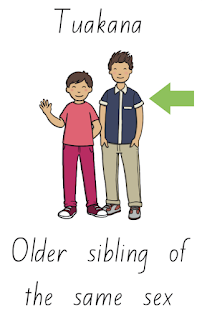
Tuakana - older sibling of the same gender


Teina or Tena  (both are correct spelling) - younger sibling of the same gender


Tuahine - sister of a boy


Tungāne - brother of a girl


Activity

Create a family portrait using traditional Māori koru's. 

Step 1) Practice your koru's on a whiteboard or scrap paper. 

Step 2) Draw and colour a koru to represent each family member.

Step 3) Glue them to a piece of black paper.

Step 4) Label your family members using the terminology above. 


Friday, August 6, 2021

Different Greetings

Knowing when and how to use different greeting in Māori can be daunting. If you're unsure or just want a reminder than look know further. Farzana has put together a helpful reminder or the differences between tena koe, tena korua and tena koutou. 


If you are greeting a whole class of children which greeting would you use?

If you were greeting the Prime minister which greeting would you use? 

If you were greeting your friends grandparents which greeting would you use?

Comment below with the answers.


Tuesday, August 3, 2021

Greetings - Te Raumati and Chisa's work


Our students have been learning how to greet people and how the greeting changes based on the number of people there are. 

They have also been learning to say the following sentences.

Here is the book - Anei te pukapuka

Here is a book - Anei a pukapuka

Here is your book - Anei to pukapuka


Leave a comment with your here is sentence and see if we can read what you've said.


Tuesday, June 8, 2021

Kapa haka practice

Our kapa haka group has been practicing very hard for our upcoming performance. Below are some warm up activities the students do before practice starts to get them engaged and energetic for the lesson ahead. The bottom photo is one of many taiaha stances and also serves as great exercise when done quickly. Good discipline and hard work from our tamariki. 


Monday, May 24, 2021

He aha tenei pukapuka

Task: Partner up and write a basic story in Māori using the question and answer template below. Completed stories will be published and used as teaching tools in the junior school. 


The story needs to be at least 10 pages long and must include pictures and words. The pictures can be drawings, animations or photos you have taken yourself.


Some examples of things you can do is classroom objects, animals, colours or numbers. 


Question

He aha tēnei?          What is this?

He aha tēnā?            What is that? (nearby)

He aha tērā?             What is that over there? (at distance from the speaker)


Answer

He _______ tēnei.         This is a ________.

He _______ tēnā?          That is a ________.

He _______ tērā?           That over there is a __________.


Example:


Q: He aha tēnei? 

A: He kurī tēnei.


Reminder! 

Always use macrons where needed, adding a macron or not having one where necessary can change the word completely.

Sunday, May 16, 2021

Juniors - Māori bookmark

Design a Māori bookmark. 


Vocabulary

To read - pānui
Book - pukapuka
Kowhaiwhai pattern - Tradition Māori art (example below)


Koru - A spiral shape often used in kowhaiwhai patterns. 


Fun fact: Carvings tell the story of our tīpuna (ancestors). Every carving you see is a carved story of the past, the present or the future.

Practice the koru shape over and over again in order to get better. It's not as easy as it looks. 


Sunday, April 4, 2021

Kahoot

Challenge

Make a kahoot for your friends about one of the following three categories:
  • Numbers, 10 upwards
  • Classroom objects
  • Feelings/Emotions
Your kahoot should be 15+ questions long.


Sunday, March 28, 2021

Junior Challenge - Animals

Pick two animals (from below) and write a story about their friendship. Replace their English name for their Māori name. Draw a picture of the animals you choose to go with your story.

Example: 
Reme and Kuri were the best of friends. Kuri has a very loud bark but Reme's baaaaa is much louder. Reme and Kuri have competitions on the farm to see who can be the loudest and Reme always wins.


Monday, March 1, 2021

Year 7&8 Museum Trip


To learn the teachings of our tupuna (ancestors) and the history of New Zealand's native people and their land.

This week the yr 8 & 7 boys went on a trip to the aukland war memorial museum to discover the information and history of moari/kapa haka. We met in the hall with Mr ogilvie, Mrs Pride, Mrs Fisiahi matua Ngrimu and matua Kingi.

Museum

After we all met we started to line up and walked into the bus. While we were in there, everyone practiced the words of kamate. When we arrived we entered the back of the museum. When we were exploring I saw a lego rocket ship and a lego sailing boat. We went in the dining room to have some snacks then went into the maori history section. Matua kingi gave us some questions to answer and we had to explore to find out. Then we went into the hotonui and learnt about the carvings and the art and we also learned what they represent. Then we started to continue searching for the answers. When it was lunch we had pizza and we had to find a partner to share it with.

Taiaha

After that we started to walk down the pukekawa hill then we had to walk around a field. After that matua Ngarimu taught us how to use a taiaha and this included eight steps. After we did them we did the whole thing using all eight steps. Then we packed all the taiha up and went back on the bus to go back to PBS.

I enjoyed the museum because we learnt a lot of things in the Marae which was called hotonui and I also found the quiz hard barbecue there were answers that I forgot.


Written by Elaario, Year 7, LS2

Sunday, February 14, 2021

My Pepeha - Senior

Challenge One (2021)


Create a digital pepeha. You may need to gather information from your whanau in order to complete this challenge.   

What is a pepeha?
A pepeha is a way to introduce yourself. It is part of a mihi (a formal speech). You explain where you come from by looking back in time and connecting with your mountain, river, canoe and family. 

It is important to begin and end with a greeting. You can begin with Tēnā koutou katoa. (Greetings to you all) and you can end with Nō reira, tēnā koutou, tēnā koutou, tēnā koutou katoa. (Therefore, greetings, greetings, greetings).


Basic template

Tēnā koutou katoa. Ko ________Tōku maunga (mountain). 
Ko________Tōku awa/roto/moana (river, lake or sea). 
Nō ________ahau (I am from). 
Ko _________Tōku kura (school). 
Ko _________ingoa whānau (family name). 
Ko __________Tōku matua (father). 
Ko __________ Tōku whaea (mother). 
Ko __________Tōku ingoa (your name). 
Nō reira, tēnā koutou, tēnā koutou, tēnā koutou katoa.

Advanced template
If you are non-Maori some of these questions might be tricky to answer. Adjust as best as you can. Miss Pryde is available for questions and support. 

Tēnā koutou katoa. Ko _________ Tōku maunga (mountain). 
Ko ____________Tōku awa/roto/moana (river, lake or sea). 
Ko ____________Tōku waka (canoe). 
Ko ____________Tōku iwi (tribe). 
Ko ____________Tōku hapū (sub-tribe). 
Ko ____________ Tōku marae. 
No ____________ ahau (I am from)
Kei ____________ Tōku kainga inaianei (I am now from). 
Ko ____________ Tōku kura (school). 
Ko _____________Tōku ingoa whānau (family name). 
Ko ____________Tōku matua (father). 
Ko _____________Tōku whaea (mother). 
Ko ______________Tōku ingoa (your name). 
Nō reira, tēnā koutou, tēnā koutou, tēnā koutou katoa.

Sunday, October 25, 2020

Junior Challenge - School Karakia

Materials: Each student will need a copy of E Te Atua

Whole class learning: Learn E Te Atua as a whole class - line by line. 

Follow up activity: To check students know the karakia, get students to cut each line out and glue it in, in order on a piece of paper. 

Extra entry: To get an extra entry in the Māori draw students can stand up in front of class and read the karakia.


 E Te Atua


Homai ki a matou

Te mana

Te mohio

Te aroha

Me te tautoko

Hei manaaki i a matou

Ko Ihu Karaiti 

To matou Ariki


Amene


Challenge #12 - Māori Gods

 Māori Gods

Sunday, August 30, 2020

Challenge #10 - Our Whakapapa

Seniors: Be creative and design an image to display your family tree.

Juniors: On an EE, draw a picture of the people you live with and label them using the glossary below. You can use a voice bite or a text box. For new entrants, they can start with just their mother and father.

Glossary

Great Grandfather - Tupuna Tāne
Great Grandmother - Tupuna Wāhine
Grandfather - Koroua
Grandmother - Kūia
Mother - Whāea
Father - Mātua
Stepmother - Whaea
Stepfather - Matua
Baby - Pēpi
Grandchild - Mokopuna
Older brother of a boy (e.g. If you're a boy, your older brother) - Tuakana
Older sister of a girl - Tuakana
Younger brother of a boy - Taina
Younger sister of a girl (e.g. If you're a girl, your younger sister) - Taina
Brother of a girl - Tungāne 
Sister of a boy - Tuāhine